800 NAKHEEL

Dubai Property Market Outlook: What International Buyers Look for in Dubai’s Property Market in 2026?
Dubai enters 2026 with a market that is both larger and more institutionally legible to international capital than it was even two years ago. Leading indices in 2025 show that the prior cycle’s rapid price acceleration is beginning to moderate, a shift that tends to reward buyers who underwrite fundamentals (cash flow, resale depth, delivery risk) rather than momentum.
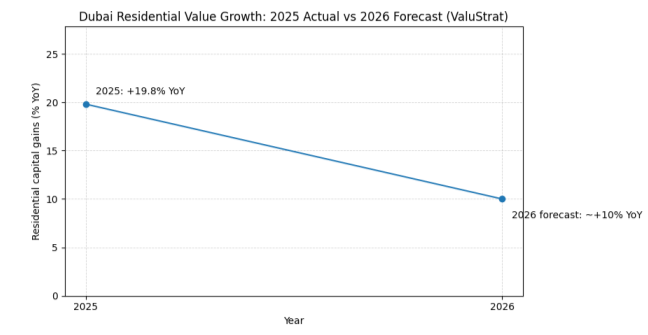
Reference: https://valustrat.com/pages/dubai-residential-values-rise-20-percent-jan-2026
Key Takeaways
Why 2026 Looks Different for Global Demand
The Macro Drivers Shaping Buyer Confidence
International buyers are responding to three signals that consistently shape cross-border allocation decisions: liquidity, transparency, and policy continuity. Dubai’s transaction scale, AED 917 billion in 2025, serves as a practical proxy for market depth and exit optionality. Meanwhile, continued reliance on regulated systems Dubai Land Department’s (DLD) open data, rental index tools, RERA governance mechanisms) reduces information asymmetry compared to many emerging-market alternatives.
There is also a clearer segmentation between prime, structurally scarce assets and commodity supply. . As market growth normalises, international demand tends to become more quality-selective, favouring locations and products with structural scarcity and proven demand continuity, while being more cautious on segments exposed to delivery concentration.
What Value Means Now,Beyond Price Per Sq Ft
For 2026 buyers, “value” is increasingly defined as risk-adjusted performance across the full hold period, not headline pricing. That typically means:
- Cash flow clarity: gross yield is not the yield that matters; net yield after service charges and recurring costs is. (Dubai’s gross yields remained robust in 2025, around 7.0% for apartments and 4.8% for villas/townhouses, but underwriting discipline is tightening.)
- Exit liquidity: the ability to resell without heavy discounting depends on buyer depth, product substitutability, and community reputation.
- Delivery risk control: buyers increasingly price certainty, including credible timelines, build quality, and governance, into what they are willing to pay.
Who’s Buying in 2026 and What They Optimise For
End-Users Vs Investors: Two Different Checklists
Both groups can be international, but they optimise differently, and the best-performing communities are those that appeal to both (supporting occupancy and resale demand).
End-User Priorities (Schools, Commute, And Community Life)
End-users tend to pay for daily-life efficiency and stability: school access, commute resilience, walkability, parks, and a community rhythm that reduces churn. These drivers underpin long-term demand because they limit displacement risk, supporting resale depth even when broader conditions soften.
Investor Priorities (Yields, Liquidity, and Risk Control)
Investors increasingly screen for four measurable controls:
- Net yield, not just asking rent (gross yields are a reference point, but costs determine the realised return).
- Liquidity (buyer/tenant depth in the submarket).
- Supply exposure (near-term completion concentration).
- Governance transparency (service charge approvals, joint-ownership rules, building management track record).
New expectations from High-Net-Worth (HNW) and Ultra-High-Net-Worth (UHNW) buyers
HNW/UHNW demand is increasingly shaped by:
- Scarcity logic (waterfront positioning, signature views, limited stock, or planning constraints).
- Design and specification standards that remain competitive versus global peers.
- Asset operability: privacy, security, arrivals, parking, maintenance standards, and consistent community management, as these determine whether a premium remains defensible over time.
Product Logic: Layout Efficiency, Quality, And Deliverability
In 2026, product scrutiny is sharper because supply is wider. Buyers typically prioritise:
- Layout efficiency
- Build quality and maintenance outcomes
- Deliverability, evidenced by developer track record, realistic handover timelines, and structured post-handover processes.
Financial Logic: Net Yields, Service Charges, and Total Cost Of Ownership
Dubai’s gross yield profile remains attractive versus many global cities, but disciplined buyers will model:
- Service charges (validated via RERA/DLD Service Charge Index, not sales assurances)
- Management fees, sinking fund implications, and maintenance quality
- Vacancy assumptions and re-letting costs
- Mortgage/FX assumptions (for cross-border buyers)
What International Buyers Ask Before They Commit
How resilient is this community across market cycles?
The practical test is whether demand is multi-source (end-users + tenants + second-home buyers) and whether the place remains competitive when new stock launches. Transaction depth and steady leasing performance generally favour communities with strong planning discipline and amenity ecosystems rather than single-feature projects.
What protects resale demand and rental continuity?
Resale strength typically follows three protections:
- Low substitutability (distinct location/product)
- Operational consistency (maintenance, security, public realm)
- Tenant relevance (access, services, and day-to-day convenience that supports retention)
Why Master-Planned Communities Continue to Win Share
Scale as a Demand Stabiliser
Scale can widen demand by serving multiple needs at once, family living, leasing demand, and lifestyle convenience, while supporting the economics of consistent upkeep. In slower phases of the cycle, this breadth often helps reduce volatility because demand is not reliant on one buyer segment alone.
Placemaking And Curation: The Source of Durable Pricing Power
Placemaking is not aesthetics; it functions as an economic lever when it extends dwell time, improves convenience, and reinforces community identity. . Curated retail, quality public realm, and walkable networks can translate into stronger tenant retention and more resilient pricing, particularly when supply competition increases.
The Role Of Developer Track Record And Community Management
In 2026, track record functions as a form of risk pricing. Communities with credible delivery history and consistent community management are more likely to sustain standards, supporting long-term desirability and protecting liquidity when market conditions become more selective.
A 2026 Outlook for International Buyers
In 2026, Dubai’s market is expected to reward selectivity over momentum as growth normalises: international buyers are therefore likely to prioritise net yields (after service charges), resale liquidity, delivery certainty, and communities with durable demand drivers. The strongest outcomes are likely to come from master-planned locations where planning discipline and long-term management protect liveability, and therefore pricing power, across cycles.
Explore Nakheel’s master-planned communities in Dubai and request a fact-based comparison of net cash flow, verified fees, handover risk, and resale depth to shortlist with confidence.