800 NAKHEEL
Why Global Capital Still Rotates into Dubai’s Waterfront Assets During Uncertain Times
During periods of geopolitical volatility, interest-rate uncertainty, and uneven global growth, capital tends to move towards assets that combine usability, scarcity, and liquidity. In Dubai, that pattern is visible in premium waterfront property, where lifestyle demand and investment logic often reinforce one another.Key Takeaways
- Why Waterfront Assets Hold Strategic Appeal in Global Real Estate
- How Waterfront Scarcity Supports Demand and Pricing Power
- Why Global Investors See Dubai Waterfront as a Defensive Play
- Waterfront Assets in Dubai’s Broader Capital Rotation Story
- Why Dubai Continues to Attract Capital During Uncertainty
- Waterfront Value in a More Selective Market
Why Waterfront Assets Hold Strategic Appeal in Global Real Estate
Waterfront assets hold strategic appeal because they combine emotional preference with investment discipline. Globally, buyers often value direct water access, views, privacy, and open-space proximity because these factors are difficult to replicate at scale. In investment terms, this positions waterfront property as structurally resilient, less dependent on short-term marketing cycles and more connected to enduring lifestyle demand.
When investors become more selective, they usually prioritise assets with clear differentiation, broader resale appeal, and a stronger ability to attract end-users. Waterfront homes often meet that test because they are purchased for yield and short-term appreciation, yet are equally held for owner-occupation, wealth preservation, legacy planning, and global mobility strategies.
How Waterfront Scarcity Supports Demand and Pricing Power
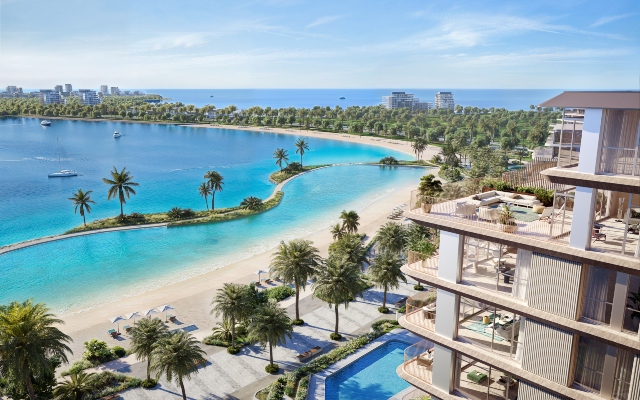
Scarcity is the core reason waterfront assets often maintain pricing power. Unlike standard residential supply, prime waterfront land cannot be reproduced endlessly. New homes can be delivered, but true shoreline positioning, sea views, beach proximity, and master-planned waterfront access remain constrained by geography and planning.
Recent market data shows how premium and low-substitute assets have led performance. ValuStrat reported that Dubai’s residential values rose 19.8% year-on-year in December 2025, while villa values increased 25.1%. Freehold villas were around 211% above post-pandemic
levels and 89% above the 2014 peak, highlighting sustained demand for spacious, lifestyle-led homes within supply-constrained communities.
Why Global Investors See Dubai Waterfront as a Defensive Play
Dubai’s prime waterfront segment benefits from several defensive characteristics: international buyer recognition, lifestyle-led occupancy, limited direct supply, and high emotional attachment among end-users.
Knight Frank recorded 500 Dubai home sales above US$10 million in 2025, including 68 transactions above US$25 million. The total value of US$10 million-plus residential sales rose 27.7% year-on-year to US$9.05 billion. This is significant because ultra-prime buyers are usually highly mobile; their continued activity signals confidence in Dubai’s lifestyle infrastructure, wealth environment, and long-term ownership proposition.
Waterfront Assets Serve Multiple Investment Purposes
Waterfront assets also serve multiple investment purposes. They can function as primary residences, second homes, rental assets, or long-term family holdings. That flexibility widens the buyer pool and supports exit liquidity, particularly when investors prioritise real assets that combine personal utility with capital preservation.
Waterfront Assets in Dubai’s Broader Capital Rotation Story
Dubai’s waterfront market is part of a wider capital rotation towards cities that offer safety, access, lifestyle quality, and future growth. Investors are not only comparing buildings; they are comparing urban systems and governance frameworks. In this context, Dubai’s waterfront communities benefit from the city’s infrastructure, population growth, tourism strength, and long-term planning.
The next phase of performance is likely to be more selective. After several years of rapid appreciation, investors are focused on quality, delivery confidence, governance, and scarcity.This selectivity further elevates waterfront assets as their value is shaped by both the residence and the surrounding destination: access, public realm, amenities, privacy, views, and the maturity of the master plan.
Why Dubai Continues to Attract Capital During Uncertainty
The emirate combines regulatory transparency, tax efficiency, infrastructure investment, international connectivity, and long-term urban planning.
The Dubai Economic Agenda D33 aims to double the size of Dubai’s economy by 2033 and position the city among the world’s top global destinations for living, working, and investing. That policy backdrop has strengthened real estate demand.
Dubai Land Department reported 1.38 million registered tenancy contracts in 2025 with a total value of AED126.4 billion, up 6% in volume and 17% in value from 2024, reflecting sustained occupier demand alongside capital inflows
Waterfront Value in a More Selective Market
Global capital continues to rotate into Dubai’s waterfront assets because they offer a rare combination of scarcity, lifestyle relevance, liquidity, and long-term investment logic. In uncertain periods, these attributes become more critical, not less . Investors move away from interchangeable supply and towards assets with clearer demand drivers, stronger emotional pull, and better potential to preserve value over time.
For buyers exploring Dubai real estate investment opportunities, Nakheel’s waterfront destinations offer access to some of the city’s most distinctive coastal communities, where planning, lifestyle, and long-term value converge. Explore Nakheel’s waterfront communities and discover residences shaped for enduring demand.